Compliance
Part 2 – AI Compliance in 2026 — Federal Direction, State Laws, and What HR Must Watch

February 3, 2026

Share This Post:

15 Minute Read
Artificial Intelligence is now embedded in HR tools that handle recruiting, performance insights, workforce analytics, and more. But as these systems become widespread, regulators are starting to pay closer attention to how employers use them.
In 2026, HR leaders are navigating an AI compliance landscape that is evolving rapidly — at both the federal and state levels — with implications for fairness, transparency, and risk management. This article breaks down what’s happening, why it matters, and what HR teams need to watch.
Read the 4 Part Series
- Part 1: AI & HR in 2026: The Big Shifts Employers Can’t Ignore
- Part 2: AI Compliance in 2026 — Federal Direction, State Laws, and What HR Must Watch
- Part 3: AI Risk in HR — Bias, Privacy, Transparency, and Employee Trust
- Part 4: Where AI Actually Works in HR — Safe, Compliant Use Cases for 2026

The Federal Approach — A National AI Framework
In December 2025, the White House issued Executive Order 14365: Ensuring a National Policy Framework for Artificial Intelligence, which sets a federal policy aimed at creating a unified approach to AI governance. The stated goal is to sustain U.S. leadership in AI while promoting a “minimally burdensome national policy framework” that limits conflicting state rules.
The order also directs federal agencies to coordinate AI policy efforts and evaluate existing state laws to identify those that conflict with federal objectives. It calls for the creation of an AI Litigation Task Force to review and challenge state-level AI laws that may conflict with the national framework.
From an HR compliance perspective, the federal emphasis on coordinated policy signals that AI governance is likely to become clearer over time — but not immediately consistent. In the short term, HR teams must operate in a landscape where federal intent and state requirements may diverge.
Why States Are Stepping In
Despite federal involvement, many states and localities are moving ahead with their own AI rules, especially where AI affects people decisions like hiring, promotions, and performance reviews. This patchwork is driven by concerns about bias, discrimination, transparency, and accountability in automated systems.
State and local rules vary widely, and multistate employers are finding it challenging to track requirements that may differ based on where they hire or operate.
Key State-Level AI Laws to Watch
Illinois
Illinois has passed legislation amending the Illinois Human Rights Act to regulate the use of AI in employment decisions, effective January 1, 2026. This law requires employers using AI in hiring or other employment functions to ensure systems don’t result in discrimination and to provide appropriate notice to applicants and employees.
Colorado
Colorado’s Colorado AI Act (CAIA) creates accountability standards for AI systems, including those used in employment settings. Initial implementation dates have shifted into mid-2026, and the law focuses on bias and adverse impacts — requiring transparency and safeguards for people subjected to high-risk systems.
Other States & Localities
- New York City has had AI hiring transparency requirements in effect for several years.
- Other states, including California and Utah, are exploring or implementing AI-focused rules, many targeted at fairness, transparency, and accountability.
This legal diversity means HR leaders need to monitor obligations in every jurisdiction where they hire or manage employees.
Where HR Is Most Exposed
AI touches core HR functions — and that’s where compliance risk starts:
- Recruitment & Hiring: AI-assisted resume screening and candidate scoring may trigger state rules around transparency and bias mitigation.
- Performance & Promotion Decisions: Systems that influence performance rankings or development paths can raise fairness concerns.
- Discipline & Termination: If an AI tool contributes to decisions that lead to adverse actions, employers must be ready to explain and justify those processes.
- Analytics & Predictive Models: Tools that profile employees or forecast attrition must be governed carefully to avoid discriminatory impacts.
The key risk isn’t AI itself — it’s AI without governance, documentation, or human oversight.
2026 AI Compliance Action List
Before AI creates bigger headaches in 2026:
- Identify where AI is used across HR functions — recruiting, performance, engagement, analytics.
- Map regulatory obligations for states where you hire or manage employees.
- Document vendor disclosures about how AI tools work, including data sources and bias mitigation.
- Create or update internal policies requiring human review before AI-influenced decisions are finalized.
- Communicate transparently with employees about where AI is used and what it means for them.
- Monitor evolving laws and guidance — adjust governance and training accordingly.
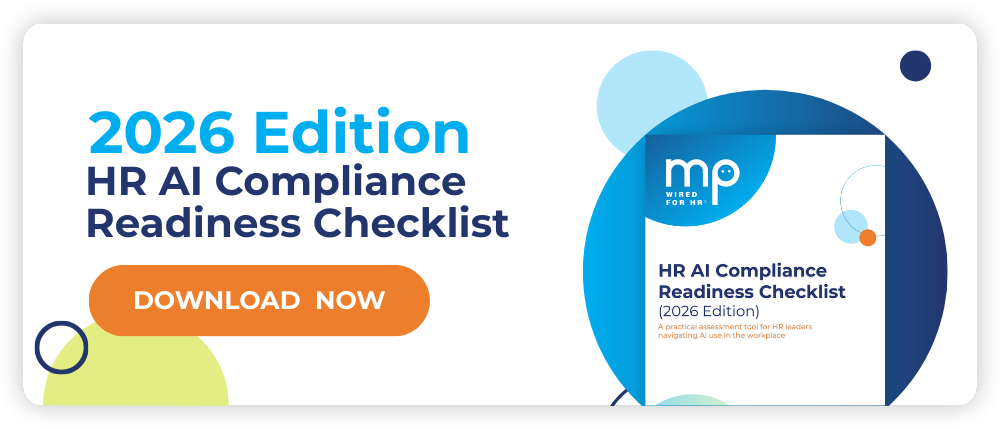
For a practical, step-by-step version of this list, grab our HR AI Compliance Readiness Checklist (2026 Edition).
👉 Download the checklist and start 2026 with clarity—not guesswork.
FAQ — AI Compliance for HR (SEO & AI Search Optimized)
What is AI compliance for HR?
AI compliance for HR refers to ensuring that the use of AI tools in HR functions like hiring, performance management, and analytics adheres to applicable laws, minimizes bias, and is transparent and explainable to employees and regulators.
Are there federal AI laws affecting HR in 2026?
As of 2026, there isn’t a single comprehensive federal AI law governing HR. However, the federal government (via a 2025 executive order) is pushing for a national AI policy framework aimed at reducing conflicting state rules and guiding agency positions on AI governance.
Do state AI laws apply to employers without a physical location in a state?
Yes. Some state laws, like Illinois’ AI employment provisions, apply to employers who hire or manage employees in the state — even without a physical office there.
What parts of HR are most likely to be regulated because of AI?
Recruitment and hiring, performance evaluation, discipline/termination decisions, and analytics are the most common areas where laws are being applied or considered.
Can federal action override state AI laws?
The federal executive order aims to encourage national consistency and challenge conflicting state laws, but only legislation passed by Congress would fully preempt state law. Until then, employers must comply with whichever laws apply where they operate.
How MP Helps Employers Navigate AI in HR
AI is moving fast. Regulations are evolving. And HR leaders are being asked to adopt new technology while still protecting their people, culture, and compliance posture.
That’s where MP makes the difference.
MP’s HR Advisory team works with employers nationwide to bring clarity and structure to AI adoption—so it becomes a strategic advantage, not a liability. We help organizations:
- Identify where AI is already influencing HR decisions
- Assess compliance exposure across federal and state requirements
- Evaluate AI-enabled vendors with the right governance questions
- Build practical internal policies and guardrails that employees understand
- Implement AI responsibly while maintaining trust and human oversight
Whether you’re just beginning to explore AI or already using AI-powered tools in recruiting and workforce management, MP provides the expertise and hands-on support to help you move forward confidently.
Want a practical starting point?
Download MP’s HR AI Compliance Readiness Checklist (2026 Edition) or connect with our experts for a short AI readiness conversation.
Let’s make sure your HR strategy is ready for what’s next.
Related Articles We Think You’ll Love

Stop Being
Just Another Number
Join 2,300+ companies who’ve discovered that industry-standard technology paired with personal service isn’t just possible, it’s profitable.